
TL;DR: The average US medical practice loses roughly $200 for every missed appointment, and no-show rates run 18–19% nationally — up to 30% in dermatology and pediatrics. In California, with 124,383 active physicians competing for patients, an empty slot doesn’t stay empty quietly: it costs revenue, staff time, and patient trust. Automated reminders alone haven’t solved it — only 13% of medical groups reported lower no-show rates in a recent MGMA survey. What works is two-way communication patients actually answer: text-based reminders they can reschedule from, plus after-hours call answering so no booking opportunity dies at 7 PM.
California has the most doctors — and the most competition for every appointment
California leads the nation with 124,383 professionally active physicians (KFF State Health Facts, May 2026, sourced from the AMA Physician Masterfile). New York is a distant second at 85,904. More doctors means more choice for patients — and less patience for friction. If booking with your clinic takes three phone calls and a hold queue, the practice down the street with online scheduling gets the visit.
At the same time, independent practice is shrinking. Just 42.2% of US physicians were in private practice in 2024, down from 60.1% in 2012 (AMA Physician Practice Benchmark Survey, published June 2025). The clinics that remain independent survive on operational efficiency. Every empty appointment slot is margin walking out the door.
What no-shows actually cost: the math nobody does
Take a typical California primary-care or dental practice:
- National average no-show rate: ~18% (Medical Economics); primary care specifically: ~19% (Clearwave); outpatient clinics: 23–33% (Curogram)
- Average revenue lost per missed appointment: ~$200 (Clearwave)
- MGMA-tracked medical groups see roughly 80 returning and 43 new patients miss appointments every month
Illustrative example: a practice booking 25 appointments a day at a 19% no-show rate loses about 5 slots daily. At $200 each, that’s roughly $1,000 a day — over $20,000 a month in unrealized revenue, before counting the staff hours spent on scheduling calls that led nowhere. Nationally, missed appointments drain an estimated $150 billion from US healthcare every year.
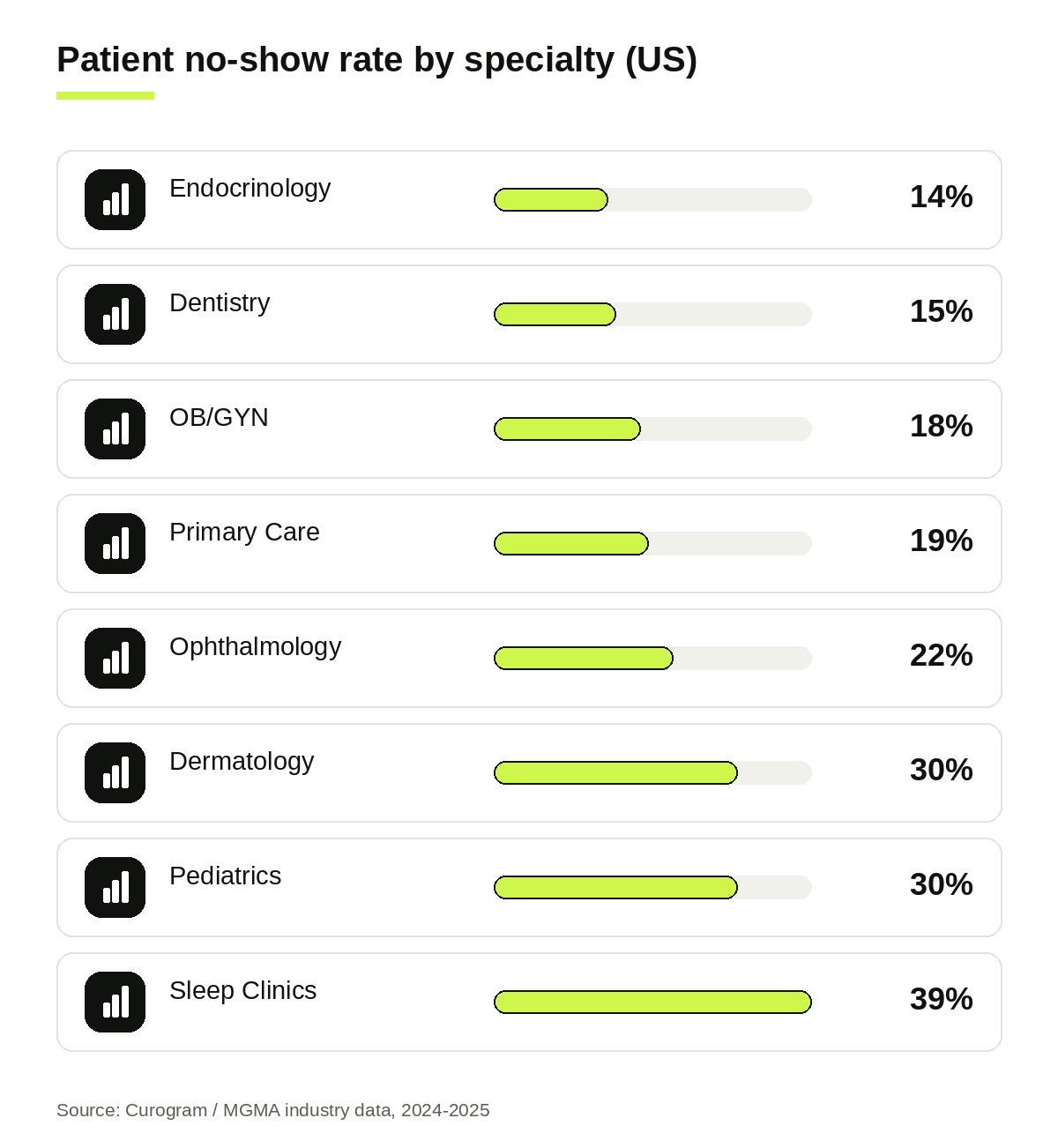
And the rate varies brutally by specialty. Dentistry sits near 15%, ophthalmology 22%, dermatology and pediatrics 30%, sleep clinics 39% (Curogram industry data). If you run a California dermatology or med-spa practice, nearly one in three booked consultations may never walk in.
Why “we already send reminders” isn’t fixing it
Most practices already send some form of reminder — and the numbers barely move. In MGMA’s January 2025 Stat poll of 622 practice leaders, 58% said their 2024 no-show rate held steady versus 2023, 20% said it got worse, and only 22% saw improvement. A separate MGMA finding: just 13% of medical groups reported a decline in no-shows at all.
The practices that did improve had a pattern: they switched from one-way reminder blasts to two-way text messaging platforms — messages patients could reply to, reschedule from, and actually converse with. The problem was never that patients didn’t get a reminder. It’s that the reminder gave them nothing to do except show up or silently not.
What actually moves the no-show number
Four mechanisms, each addressing a real reason patients miss visits:
1. Two-way SMS reminders with one-tap rescheduling. “Reply C to confirm, R to reschedule.” A patient who can move Tuesday to Thursday in ten seconds doesn’t become a no-show — they become a kept appointment on a different day.
2. After-hours call answering. A large share of appointment calls happen outside office hours. If nobody picks up at 7:40 PM, that patient books elsewhere or doesn’t book at all. An AI receptionist that answers, qualifies, and books directly into the schedule recovers those calls instead of losing them to voicemail.
3. Smart recall for dormant patients. Hygiene recare, annual physicals, follow-up imaging — the patients who drifted. Automated, personalized outreach (“It’s been 8 months since your last cleaning — want Thursday at 3?”) refills the schedule without staff phone time.
4. Waitlist backfill. When a cancellation does come in, the slot should refill within minutes, not sit empty. Automated waitlist outreach texts the next matching patients until the slot fills.
Old way vs. the automated way
| Task | Manual front desk | With automation |
|---|---|---|
| Appointment reminders | Staff calls, often unanswered | Two-way SMS, patient confirms or reschedules in seconds |
| After-hours calls | Voicemail (most callers hang up) | AI answers, books directly into the calendar |
| Cancellations | Slot sits empty | Waitlist auto-texted until slot refills |
| Dormant patients | Never contacted | Automated recall campaigns by visit type |
| Rescheduling friction | Patient must call during office hours | One-tap reschedule from the reminder itself |
Frequently asked questions
What is a normal no-show rate for a California clinic?
Nationally, ~18% across all practices (Medical Economics). Primary care runs ~19%, dentistry ~15%, dermatology and pediatrics ~30%. If you’re above your specialty’s benchmark, the gap is recoverable revenue, not bad luck.
Do automated reminders actually reduce no-shows?
One-way reminders alone show weak results — only 13% of medical groups reported declines (MGMA). Two-way texting platforms, where patients can confirm or reschedule by reply, are what the improving practices switched to.
How much does a single no-show cost?
Industry estimates put it around $200 per missed appointment in lost revenue (Clearwave), before staff time. Two no-shows a day can exceed $50,000 a year for one practice.
Can’t my front desk just handle this?
Front desks are already overloaded — and they’re closed when many patients call. Automation doesn’t replace your staff; it handles the repetitive outreach so your team spends time on patients who are actually in the building.
How fast can this be set up for a clinic?
A focused no-show reduction system — two-way reminders, AI call answering, waitlist backfill — is typically a weeks-long implementation, not a months-long IT project. The reminder layer usually goes live first because it’s the fastest win.
About the author: Malik Kashif is a GoHighLevel Systems Engineer who designs and builds AI automation systems — AI receptionists, booking engines, and follow-up automation — for healthcare practices and service businesses.
Sources: KFF State Health Facts (May 2026, AMA Physician Masterfile); AMA Physician Practice Benchmark Survey (June 2025); MGMA Stat polls (Jan 2025, Aug 2024); Medical Economics; Curogram industry data; Clearwave; Becker’s Hospital Review.
Running a California practice and tired of empty slots? Book a free strategy call — we’ll map exactly where your schedule is leaking and what automation recovers first.