
How big companies get hundreds of reviews
An HVAC owner on r/ProHVACR asked how the big companies moving into his area get hundreds of Google reviews in a couple of months. The top reply was “buy them.” Some do, and those get removed. The rest run a system a 3-truck shop can copy. Here it is, with the math.
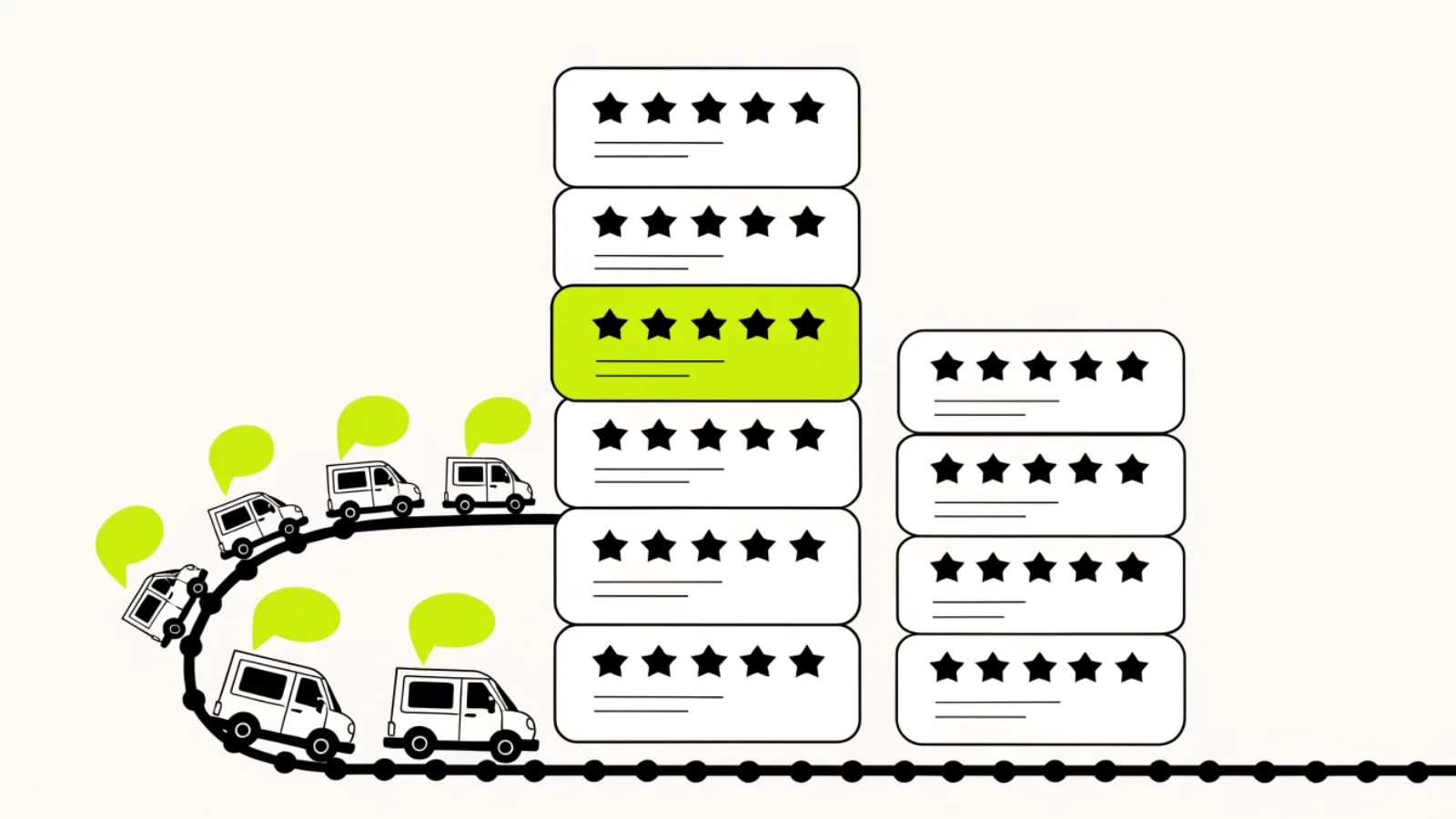
How do large home-service companies get so many reviews?
Jobs times a system. A 40-truck HVAC company does 200 jobs a day; if an automated text from the tech’s name goes out after every one and 25% of customers post, that’s 50 reviews a day. The “secret” is that nobody at the big company remembers to ask; the job-complete event asks for them. BrightLocal’s 2026 survey found 83% of customers asked for a review leave one, which means the ceiling is far higher than 25%. A 3-truck shop doing 15 jobs a day with the same system books 3–5 reviews a day, or 100 a month, which is more than most big companies in a small market.
| Company | Jobs a day | Ask rate | Post rate | Reviews a month |
|---|---|---|---|---|
| Big company with a system | 200 | 100% (automated) | 25% | about 1,500 |
| Big company, no system | 200 | 10% (techs remember) | 30% | about 180 |
| 3-truck shop with a system | 15 | 100% (automated) | 30% | about 135 |
| 3-truck shop, no system | 15 | 10% | 30% | about 14 |
What does the system actually do?
Job marked complete in the job software
That’s the trigger. ServiceTitan, Housecall Pro, Jobber or the CRM.
Service check-in text, 1 hour later
“Is everything right with the AC?” Problems reply here and go to the owner; the review ask still goes to everyone (no gating).
Review ask, 2 hours after a repair, 2–3 days after an install
From the tech’s name, with the direct Google review link. Under 200 characters.
One reminder, day 3
Same link, lighter tone. Then stop.
Owner replies within a week
Real sentence about the job. 89% of consumers expect it; templated replies put off half.
Monthly numbers
Sent, delivered, posted, replied. Big companies watch posted-per-job by tech and coach the low ones.
What about the ones who buy reviews?
Some do, and the pattern is visible: dozens of reviews in a week from accounts with no history and similar wording. Google removes them in batches and can suspend the profile; the FTC’s 2024 rule carries civil penalties per fake review and has been enforced against both buyers and sellers. A big company with 400 real reviews and 200 bought ones ends up with 400 and a warning. You can’t catch up by cheating and you don’t need to.
How does a small shop close the gap in 90 days?
- Days 1–7: set the automated ask on job-complete, from each tech’s name, with the direct link. Add the check-in text before it.
- Days 8–30: send a one-time ask to the last 12 months of happy-looking customers (consent on file), spread over three weeks so it doesn’t look like a burst. Expect 10–15% to post.
- Days 31–90: let the system run; reply to every review inside a week; watch posted-per-tech.
- Target: past 20 reviews in month one (47% of consumers won’t use a business under 20), past 50 by day 90, and a steady 30+ a month after that, which beats the big company’s recency in your zip because 74% of consumers only trust reviews from the last three months.
Texas notes
The one-time ask to past customers is a text to existing customers about a job you did, not a solicitation under SB 140, but keep it 9 a.m.–9 p.m. from your registered number, and don’t attach an offer to it. In DFW and Houston the big-company review counts are the highest in the state; the small shop’s edge is recency and reply quality, which the system produces and the big company’s call centre doesn’t.
Questions owners ask
Do big companies pay for reviews?
Some buy them and get removed; most run an automated ask after every job. The second is legal and copyable.
How many reviews a month should a 3-truck shop get?
With an automated ask: 60–130. By hand: 10–20.
Can I ask past customers all at once?
Spread it over three weeks and only with consent on file. A burst from one day looks bought.
What’s a realistic post rate?
25–35% of asked customers with a named sender, right timing and direct link. Generic asks: 10–20%.
Do reviews need to be 5 stars?
No; a 4.7 with 300 recent reviews beats a 5.0 with 12. Recency and volume both matter.
Should techs ask in person too?
Yes, a sentence at the door, then the text does the rest. No tablets on the spot.
What about replying?
Every review, within a week, with a sentence about the actual job. Half of consumers are put off by templates.
Does this work for cleaning or lawn care?
Yes; ask once after the third visit for recurring clients, then every six months.
Can the AI receptionist run this?
The same workflow that books the job sends the check-in and the ask. One system.
How long until it shows in rankings?
Local pack and LSA position move within a few weeks of steady new reviews.
Next pages
Sources
- BrightLocal, “Local Consumer Review Survey 2026”: brightlocal.com
- FTC, Rule on the Use of Consumer Reviews and Testimonials, 16 CFR Part 465: ftc.gov
- Owner thread: r/ProHVACR
Want the review system running after every job?
Thirty minutes on Central Time. We connect job-complete to the check-in and the ask in each tech’s name, and you watch the count move in the first month.