
Which states require consent to record business calls?
Thirteen states require every party on a call to consent before it is recorded: California, Connecticut, Delaware, Florida, Illinois, Maryland, Massachusetts, Montana, Nevada, New Hampshire, Oregon (in-person), Pennsylvania and Washington. The other states and federal law need only one party. The safe default for any business is to announce recording on every call.
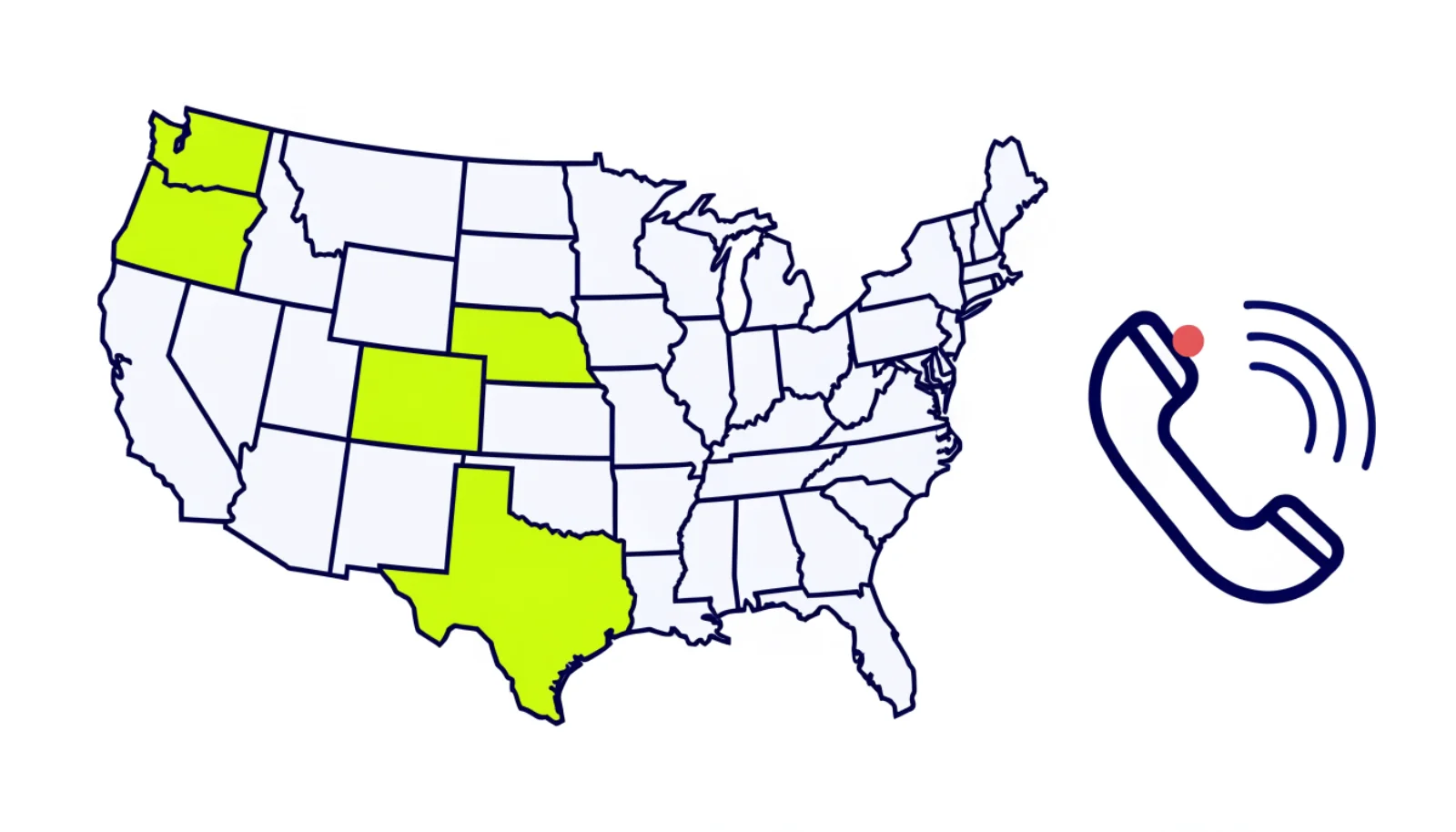
What is the difference between one-party and all-party consent?
One-party consent means a call can be recorded as long as one participant agrees, and a business recording its own calls is that participant. All-party consent, often called two-party consent, means every person on the call must agree before recording starts. Federal law, 18 U.S.C. 2511(2)(d), is one-party; thirty-seven states and the District of Columbia follow it, and thirteen states require all parties.
For a local business the distinction decides one thing: whether a short announcement at the start of each call is optional or mandatory. Because missed-call text-back, AI receptionists and call tracking all involve recording, the question comes up in almost every automation project we build.
- Federal baseline: one-party, 18 U.S.C. 2511
- 37 states plus DC: one-party (Vermont has no statute and follows the federal rule)
- 13 states: all-party, listed in the table below
How many states need all-party consent?
Which states require all-party consent to record a call?
Every state not in this table follows the one-party rule, including Texas, Arizona, Georgia, New York, Ohio, North Carolina, Colorado and Virginia. Michigan’s statute reads as all-party but courts recognise a participant exception, so most guides classify it as one-party; we still recommend announcing.
| State | Statute | What to know |
|---|---|---|
| California | Penal Code 632 | Applies to confidential communications; also covers cordless and mobile calls. Statutory damages of $5,000 per violation. |
| Connecticut | Gen. Stat. 52-570d | Civil statute for telephone calls. Consent can be a recorded announcement or an audible beep at intervals. |
| Delaware | 11 Del. C. 2402 and 1335 | Two statutes conflict; treated as all-party by most compliance guides. |
| Florida | Stat. 934.03 | All-party for any wire, oral or electronic communication. Felony exposure for violations. |
| Illinois | 720 ILCS 5/14-2 | Rewritten in 2014; still all-party for private conversations. |
| Maryland | Cts. & Jud. Proc. 10-402 | All-party. One of the strictest; also a felony. |
| Massachusetts | Gen. Laws ch. 272 s. 99 | All-party, with no “reasonable expectation of privacy” test; secret recording is the offence. |
| Montana | Code 45-8-213 | All-party, with exceptions for public officials and emergencies. |
| Nevada | NRS 200.620 and 200.650 | All-party for telephone calls; one-party for in-person conversations. |
| New Hampshire | RSA 570-A:2 | All-party. Courts have applied it to calls with out-of-state parties. |
| Oregon | ORS 165.540 | All participants must be informed for in-person conversations; telephone calls are one-party. |
| Pennsylvania | 18 Pa. C.S. 5704 | All-party. Applies to business calls, including customer service recordings. |
| Washington | RCW 9.73.030 | All-party; an announcement at the start of the call that is itself recorded satisfies consent. |
Where does recording happen in a lead follow-up system?
AI receptionist
Every answered call is captured and transcribed. Put the notice in the first sentence of the greeting so it is on the recording itself.
Call tracking numbers
Dynamic numbers on ads and landing pages often record by default. Enable the whisper or announcement and set a retention period.
Power dialers and callbacks
Outbound calls from the CRM can be recorded. Staff should announce it; in all-party states it is required before the conversation starts.
Voicemail and missed-call text-back
A voicemail is a recording the caller knowingly leaves, so no extra consent is needed. The text-back itself is covered by SMS consent rules, not recording law.
How do you make call recording compliant in a few minutes?
Write one announcement and use it everywhere
“Thanks for calling [practice]. This call is recorded for quality and training.” Put it in the IVR, the AI receptionist greeting and the call tracking whisper.
Record the announcement too
Start recording before the notice plays, so the consent evidence is in the file. Washington’s statute specifically accepts this.
Apply the all-party standard to every call
Mobile callers can be anywhere. Treating every call as an all-party call removes the need to guess.
Set retention and access
Decide how long recordings are kept, who can play them and how they are deleted. For clinics, recordings are PHI and need the HIPAA controls on our clinic follow-up page.
Update the privacy policy
State that calls are recorded, why, how long they are kept and who to contact. Link it from the booking page.
Do these laws cover video, chat and AI transcripts?
Recording statutes were written for voice, but many apply to any “oral” or “electronic” communication, which courts have read to include video calls and, in some cases, chat transcripts. Chat is usually safe because the customer is typing into your system knowingly, but an AI agent that joins a video consultation and transcribes it needs the same announcement as a phone call. Illinois adds a separate rule for biometrics under BIPA, which matters if a voice agent attempts speaker identification; most lead follow-up agents do not.
This page is general information for business owners, reviewed against the official sources linked in the text. It is not legal advice. Laws change and enforcement varies, so confirm your own setup with a licensed attorney in your state.
Common questions about call recording laws
Does an AI receptionist count as recording?
Yes. AI voice agents work by capturing the audio, transcribing it and usually storing the recording. Treat every AI-answered call as a recorded call and include the recording notice in the agent’s greeting.
Is a “this call may be recorded” message enough?
In all-party states, a clear announcement at the start of the call, followed by the caller staying on the line, is treated as consent in practice. Keep the recording so the announcement itself is on tape. In one-party states the business is a party, so the announcement is good practice rather than a requirement.
What if my business is in a one-party state but the caller is in California?
Courts have applied the stricter state’s law in cross-border cases, most notably California’s. Because local businesses cannot know where a mobile caller is standing, the safe rule is to announce recording on every call regardless of your own state.
Do call tracking numbers for Google Ads record calls?
Most call tracking tools can record and some do by default. Check the setting, add the whisper or announcement, and make sure the recording retention period matches your privacy policy. See our call tracking setup guide.
Can staff listen to recordings for training?
Yes, once the call was lawfully recorded. Access should be limited to people who need it, and for clinics the recordings are PHI and fall under HIPAA as well.
What are the penalties for recording without consent?
They range from civil damages of a few thousand dollars per call to felony charges in Florida, Maryland and Pennsylvania. Class actions over recorded customer-service calls in California have settled for millions, which is why the announcement matters even for a small business.
What is related to call recording laws?
No auto-renew. You own everything. Paid on booked appointments.
Every system we build sits in your own account, on your own numbers and domain. If you stop working with us, nothing switches off and nothing has to be migrated.
Want an AI receptionist that announces, records and books correctly?
Book a free strategy call. We set up the greeting, retention and access rules as part of every build, in your own account.