
The roofing storm playbook
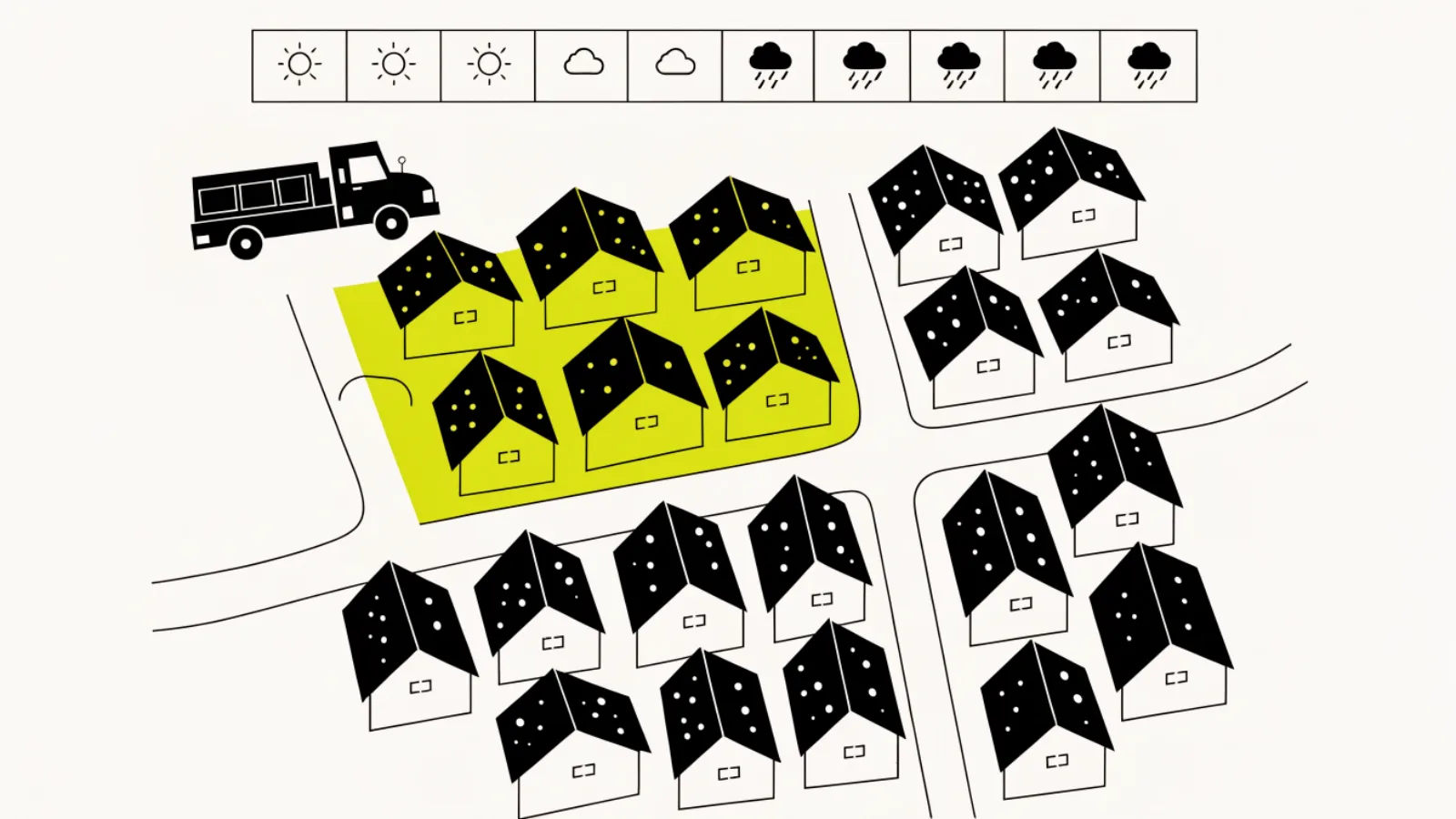
The hail stops at 6 p.m. By 7 your phone has taken 80 calls and five out-of-state trucks are already on the street. The next ten days decide the year. Here’s the hour-by-hour: who answers, how inspections get batched, how adjuster visits get booked, and the follow-up that turns inspections into signed claims.
What should a roofing company do in the ten days after a hail storm?
Flip to AI-first answering the night of the storm so no call rings out; book free inspections in neighbourhood batches so one crew leader covers one subdivision a day; ask every caller whether a claim is filed and who the carrier is; schedule the roofer to meet the adjuster; and run a follow-up sequence on every inspection that doesn’t sign on the spot, because 40–50% quote-to-close on replacement means half your inspections are still open on day ten. Replacement tickets run $8,000–$15,000, and the company that answered first and showed up first gets most of them.
| Storm number | Figure | Source |
|---|---|---|
| Calls in the 10 days after a major hail event, mid-size DFW roofer | 300–600 | Client call logs |
| Largest hail, 25 and 28 April 2026 | Softball size (Parker, Wise, Johnson, Hill counties) | NWS Fort Worth |
| Tornadoes confirmed in the same outbreak | 11, including an EF3 at Mineral Wells | NWS Fort Worth |
| Replacement ticket (2026) | $8,000–$15,000 | Foundry CRO 2026 |
| Quote-to-close, roofing replacement | 40–50% | Foundry CRO 2026 |
| Callers who leave voicemail | Under 3% | Invoca, via Hatch |
| Per-call live-service overage on 500 storm calls | $4,000–$6,000 | Vendor pricing, Oct 2026 |
What happens in the first 72 hours?
Storm night (hours 0–6)
Flip the switch: AI answers first, office works the list. Script: active leak? ceiling sagging? address, visible damage, claim filed? Book inspection windows by zip. Emergency tarps to the on-call lead.
Day 1 morning
Crew leaders get their batched inspection lists by subdivision. Office calls back anyone the AI flagged as “wants a person.” First follow-up text goes to every overnight caller: “Joe will be in your neighbourhood today between 1 and 4.”
Day 1–3
Inspections. Every inspection ends with one of three outcomes logged: signed, claim filed and adjuster date pending, or thinking. Each outcome starts its own sequence.
Day 3–7
Adjuster meetings; the AI books them when the homeowner calls with the date. Second and third follow-ups to the “thinking” group with a specific slot and the crew-in-your-street line.
Day 7–10
Fourth and fifth follow-ups; the “no pressure, we’ll patch the two bad spots for $650 and keep the quote open” offer to the holdouts. Review asks to the signed jobs.
Day 10+
Switch back to office-first. Run a 30-day missed-call audit on the storm window; the number tells you what next spring’s setup needs.
Why batch inspections by neighbourhood?
Because a crew leader doing Frisco at 9, Mansfield at 11 and Denton at 2 does five inspections a day, and the same leader doing one subdivision does fifteen. After the 27 April 2026 storm the damage ran along a line through northeast Dallas, Rockwall and Hunt counties; a company that batched by that line inspected three times as many roofs as one that took calls in order. The AI does the batching if you give it a crew-leader map and zone windows; the office can’t at 80 calls an hour.
What does the follow-up say after an inspection?
- Signed: confirmation, materials and crew date, the on-the-way text on install day, the review ask after.
- Claim filed, adjuster pending: “Has the adjuster been out yet? If the number comes back low, send me the report and I’ll show you what to push back on.” Then a text the day after the adjuster date.
- Thinking: day 2 one-question text; day 4 “crew in your street Thursday and Friday”; day 7 call; day 10 patch-now-replace-later offer; day 14 close the file.
- Went with someone else: thank them, tag for a six-month check-in; the out-of-state crews leave, and some of those jobs come back as warranty calls you can win.
Every text comes from a named person at a named company with the licence or registration details in the signature, and none of them mentions the deductible.
Texas rules that bite in storm weeks
- Deductibles. Texas bars contractors from paying, waiving or rebating the insurance deductible; the AI script never discusses it, and the written contract states the homeowner pays it.
- Three-day cancellation. A storm-related roofing contract signed after a disaster can be cancelled within three days; build the wait into scheduling.
- No state roofing licence. Texas has none, so homeowners are told to check insurance and references; put your insurance certificate and local references in the follow-up texts.
- Texting. Replies and confirmations to people who called you are fine under SB 140; a “free inspection” blast to a storm-hit zip is a solicitation and needs consent. 9 a.m.–9 p.m.
- Price gouging. After a declared disaster, keep pricing talk with the roofer, not the AI.
The DFW page and the Texas texting rules page have the detail.
Questions owners ask
When do I flip to AI-first?
The night of the storm, before the surge, and back to office-first about day ten.
Can the AI take 100 calls at once?
That’s the point of using it. Ask your vendor to show concurrency, not describe it.
Should the AI tell homeowners to file a claim?
No. It asks whether one is filed and books the inspection. Claim advice is the roofer’s job.
What about active leaks at night?
Catch-water script, ceiling-sag check, emergency tarp window, text to the on-call lead.
How do I compete with out-of-state storm chasers?
Answer first, show up first, and put local references and insurance in every follow-up. They can’t do the third.
How many follow-ups after an inspection?
Five over 14 days to the “thinking” group, each one different.
Do I need a live answering service as well?
As a fallback if the AI fails, yes; as the primary in a storm, the per-call overage will hurt.
How do I batch if I don’t have a crew-leader map?
Make one now: zips or subdivisions per leader. It’s the single setup step that triples inspections.
What do I do with the leads I couldn’t inspect in time?
Follow them up anyway; the out-of-state crews leave in two weeks and the warranty calls start.
How long does setup take?
A week to build, two weeks of after-hours tuning. Do it in February.
Next pages
Sources
- NWS Fort Worth, “April 24–29, 2026 Severe Storms & Tornadoes”: weather.gov
- Foundry CRO, “Home Services Marketing Benchmarks 2026,” 29 Apr 2026: foundrycro.com
- Nextiva, “Answering Service Cost 2026” (per-call overage): nextiva.com
Want the storm switch ready before March?
Thirty minutes on Central Time. We build the storm script, the crew-leader map, the adjuster booking and the inspection follow-up. The night the hail stops, you flip one switch.